 TechAnalyzer Pro
UnitedHealth Group Incorporated UNH
Stock research in plain language · As of Nov 29, 2026 · updated once a week, after the trading week closes
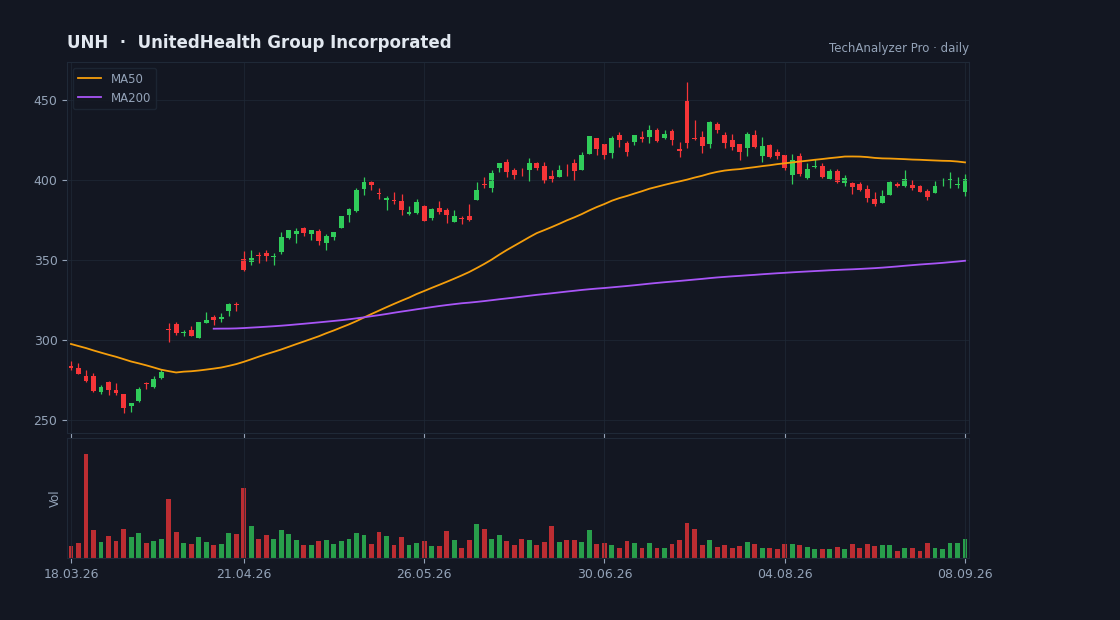
Daily candles, 50 and 200-day averages and volume · updated every trading day · click to open the live chart
The bottom line
This week the stock moved on regulation rather than results: CMS's proposed Star Ratings change and Medicare-for-All talk both touch profitability in government plans, the core of the business. Last quarter revenue was $112.7bn (down 0.4% year over year) with $4.1bn net income and EPS of 4.69 versus a 4.12 estimate, and the shares rose 6.33% in the week against 1.74% for the S&P 500. The P/E of 20.1 versus a 14.3 peer median means the price assumes earnings power holds up even without revenue growth. The central tension: the average analyst target of $473.69 sits well above the $351.41 close, while Leerink's analysis points to a potentially steep hit to quality-bonus payments.
An explanation of the mechanics from the facts on this page, not advice.
What the company does
UnitedHealth Group Incorporated is a mega-cap company in the Healthcare sector (Healthcare Plans), with a market value of $314.9B, based in the USA.
It employs about 390,000 people and has been listed since Oct 26, 1984.
UnitedHealth Group Incorporated operates as a health care company in the United States and internationally. It operates through four segments: Optum Health, Optum Insight, Optum Rx; and UnitedHealthcare. The Optum Health segment provides care delivery, care management, wellness and consumer engagement, and health financial services with patients, consumers, care delivery systems, providers, employers, payers, and public-sector entities.
Cheap or expensive? relatively expensive
Its price-to-earnings (P/E) is 20.1 versus 14.3 for 4 direct peers — relatively expensive.
Revenue is shrinking 0% versus the same quarter last year.
On analysts' next-year forecasts the multiple drops to 14.6 — they expect higher earnings.
The average analyst price target is 473.69, 35% above the current price (their view, not ours).
The stock sits at 48% of its one-year range (0% = the low, 100% = the high).
The risks
- No risk flags were detected from the data we have.
Strengths
- ✅ Profitable — 4 of every 100 dollars of revenue stays as profit.
- ✅ Generates free cash flow — profit becomes cash in the bank.
- ✅ Buys back its shares (1% fewer shares in a year).
- ✅ Most analysts rate it buy (23 vs 0).
- ✅ Pays a dividend (2.6% a year).
What the market is talking about this week
Medicare regulation takes center stage: the CMS Star Ratings proposal and Medicare-for-All talk, against a stock that rose 6.3% in the week.
- Leerink Partners estimates that under CMS's proposed Star Ratings changes, only 9% of UnitedHealth's Medicare Advantage members would be in 4-star-plus plans, versus 68% today. [4]
- Lower star ratings mean smaller government quality-bonus payments, which fund member benefits. The proposed change would apply to the 2028 measurement period for 2030 ratings. [4]
- Trump said he will meet Senator-elect El-Sayed about a 'Medicare for All' plan rebranded 'TrumpCare', saying healthcare is an area he is willing to negotiate. [2]
- An opinion piece notes the stock fell 31.8% over three years and trades near 19.8x earnings, below the industry average, amid fears over the proposed CRUSH rule. [1]
- Two ETFs sold UnitedHealth shares that week: XLV trimmed $28.9 million and JPMorgan's Active Value ETF sold $22.6 million. [3] [5]
A summary of the articles below only, each point with its source. Not a forecast, not a recommendation.
What to watch
- Progress of the CMS Star Ratings proposal and company responses; it determines how much quality-bonus money flows into Medicare Advantage plans. [4]
- Whether a date is set for the Trump–El-Sayed meeting and what emerges on Medicare for All, which touches the role of private insurance. [2]
- The next quarterly report: whether revenue returns to growth after the 0.4% year-over-year decline, and whether EPS again beats estimates.
- Whether large ETFs such as XLV and JAVA keep trimming, which affects the supply of shares in the market. [3] [5]
What changed this week
Over the past week the stock rose 6.3% (for comparison: S&P 500 +1.7%, sector ETF XLV +3.8%).
This week's news
- UnitedHealth (UNH) Stock Still Looks Like A Bargain Despite CMS Rule Fears finance.yahoo.com · 2026-11-28
A valuation piece notes the stock is down 31.8% over three years and trades at about 19.8x earnings versus a 24.6x industry average, amid CRUSH rule and Medicare-for-All worries. source ↗ - Trump to meet Abdul El-Sayed on golden ‘TrumpCare’ proposal seekingalpha.com · 2026-11-27
Trump told the New York Post he will meet Senator-elect Abdul El-Sayed to discuss expanding Medicare to all Americans, an initiative rebranded 'TrumpCare'. source ↗ - JPMorgan Active Value ETF (JAVA) Buys $30.3 Million More Cencora on Nov. 25 finance.yahoo.com · 2026-11-27
JPMorgan's Active Value ETF (JAVA) sold $22.6 million of UnitedHealth shares on Wednesday, alongside sales of HCA, Microsoft and Johnson & Johnson. source ↗ - Could CMS' Proposed Star Ratings Changes Slow ELV's MA Recovery? finance.yahoo.com · 2026-11-26
An article on Elevance cites Leerink analysis that under CMS's proposed Star Ratings rules, UnitedHealth's share of Medicare Advantage members in 4-star-plus plans would fall from 68% to 9%. source ↗ - State Street Health Care Select Sector SPDR (XLV) Sells LLY and JNJ on Nov. 24 finance.yahoo.com · 2026-11-26
The XLV healthcare sector ETF sold across all 60 holdings on Tuesday, including $28.9 million of UnitedHealth; its weight in the fund stands at 4.6%. source ↗ - ETFs Are Net Sellers of Thermo Fisher (TMO) on Nov. 24 finance.yahoo.com · 2026-11-26
An ETF-flows roundup about Thermo Fisher; it does not concern UnitedHealth. source ↗
What changed since last week
• Valuation moved from "priced in line with its group" to "relatively expensive".
• Risk flag cleared: high volatility.
• The price rose 3.4% since the last summary.
A description of facts from the filings and the market — not investment advice or a recommendation. "Cheap" and "expensive" are always relative to the comparison group. Educational information only — not investment advice. Not a registered investment adviser or broker-dealer.