 TechAnalyzer Pro
Ormat Technologies Inc ORA
Stock research in plain language · As of Oct 12, 2026 · updated once a week, after the trading week closes
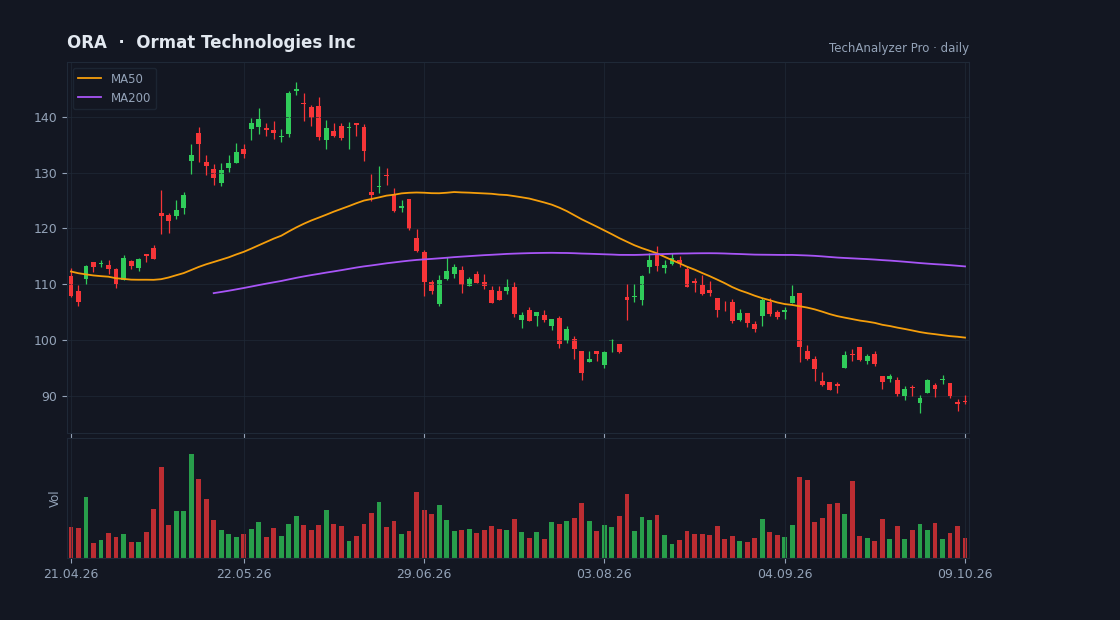
Daily candles, 50 and 200-day averages and volume · updated every trading day · click to open the live chart
What the company does
Ormat Technologies Inc is a mid-cap company in the Utilities sector (Utilities - Renewable), with a market value of $5.5B, based in the USA.
It employs about 1,648 people and has been listed since Nov 11, 2004.
Ormat Technologies, Inc. engages in the geothermal and recovered energy power business in the United States, Indonesia, Kenya, Turkey, Chile, Guatemala, Guadeloupe, New Zealand, Honduras, France, Indonesia, the Philippines, and internationally. It operates through three segments: Electricity, Product, and Energy Storage.
Cheap or expensive? relatively expensive
Its price-to-earnings (P/E) is 43.6 versus 20.8 for the median of the Utilities sector in our universe (9 companies) — relatively expensive.
Revenue is growing 11% versus the same quarter last year.
On analysts' next-year forecasts the multiple drops to 35.8 — they expect higher earnings.
The average analyst price target is 126.33, 42% above the current price (their view, not ours).
The stock sits at 3% of its one-year range (0% = the low, 100% = the high).
The risks
- • More cash leaves than comes in (negative free cash flow).
- • Net debt is 1.1× shareholders' equity — high leverage.
- • 11% of the float is sold short — part of the market is betting on a decline.
- • The stock is 39% below its one-year high.
Strengths
- ✅ Profitable — 10 of every 100 dollars of revenue stays as profit.
- ✅ Most analysts rate it buy (7 vs 0).
- ✅ Pays a dividend (0.5% a year).
What changed this week
Over the past week the stock fell 4.2% (for comparison: S&P 500 +1.2%, sector ETF XLU +4.0%).
No notable news about the company was found in the past week.
What changed since last week
This is the first summary for this stock; from next week this section shows what changed.
A description of facts from the filings and the market — not investment advice or a recommendation. "Cheap" and "expensive" are always relative to the comparison group.